
Greenbrix Capital · Blog
Private Mortgages in Ontario: The Most Misunderstood Tool in Lending
Bank said no? Learn how private mortgages in Ontario really work, what they cost, and when they’re the smartest move, from an experienced broker.
By Krystian Catala, Principal Broker, Greenbrix Capital

Say the words “private mortgage” at a dinner party and watch the room change. Somebody pictures a loan shark. Somebody else assumes you are in trouble. Somebody’s uncle tells a story about a guy who lost his house.
Here’s what I’ve learned after years of arranging mortgages across Ontario: a private mortgage is not a sign that something has gone wrong. It is a tool for getting something done when the banks cannot move fast enough or do not fit your situation. Used the right way, for the right amount of time, with a clear way out, it can save a family’s finances, close a deal that would otherwise die, or buy someone the year they need to get back on their feet.
Used the wrong way, it can get expensive. So let’s talk about both, honestly.
What is a private mortgage, really?
A private mortgage is a loan secured against real estate that comes from a private lender instead of a bank or credit union. That lender might be an individual investor, a group of investors, or a mortgage investment corporation (MIC) that pools money from many people.
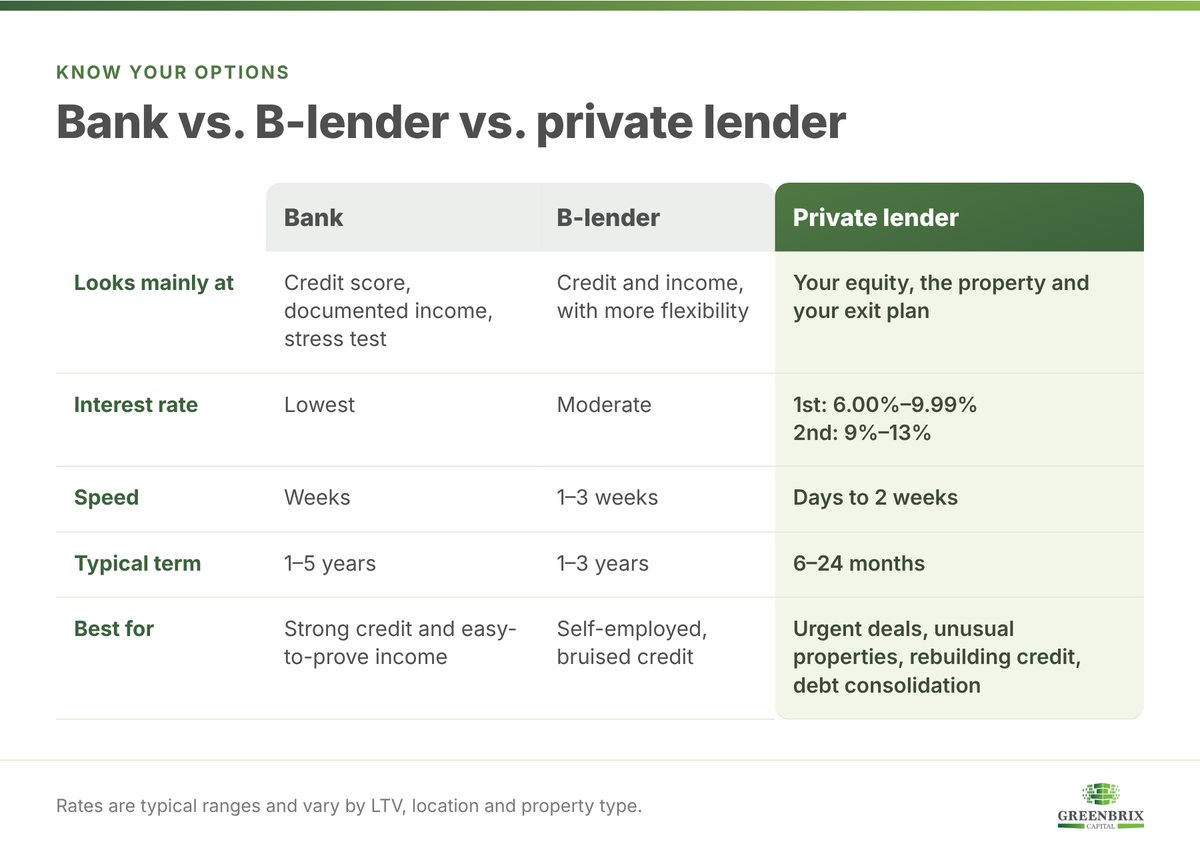
The big difference is how they make decisions. A bank looks at you through a narrow window: your credit score, your T4 or two years of tax returns, your debt ratios and the federal stress test. If you do not fit the box, the answer is no, no matter how much equity you have or how good the deal is.
A private lender looks mainly at the property and the plan. How much equity is there? What is the property worth and how easy would it be to sell? And most importantly: how will this loan be paid back?
Private mortgages are usually short, typically 6 to 24 months. Many are interest-only, which keeps the monthly payment low. They can be a first mortgage or a second mortgage behind your existing one.
Where the stigma comes from
The bad reputation did not come out of nowhere. For years, private lending was the corner of the industry where you would occasionally find borrowers who were never shown the full cost, loans with no realistic exit, and lenders happy to see a property go to power of sale.
But the industry today is a different place. In Ontario, mortgage brokerages are licensed and regulated by the Financial Services Regulatory Authority of Ontario (FSRA). When a broker arranges a private mortgage, you must receive written disclosure of the costs, the terms and the risks before you commit. Many private lenders are professional, well-capitalized MICs that do this every day.
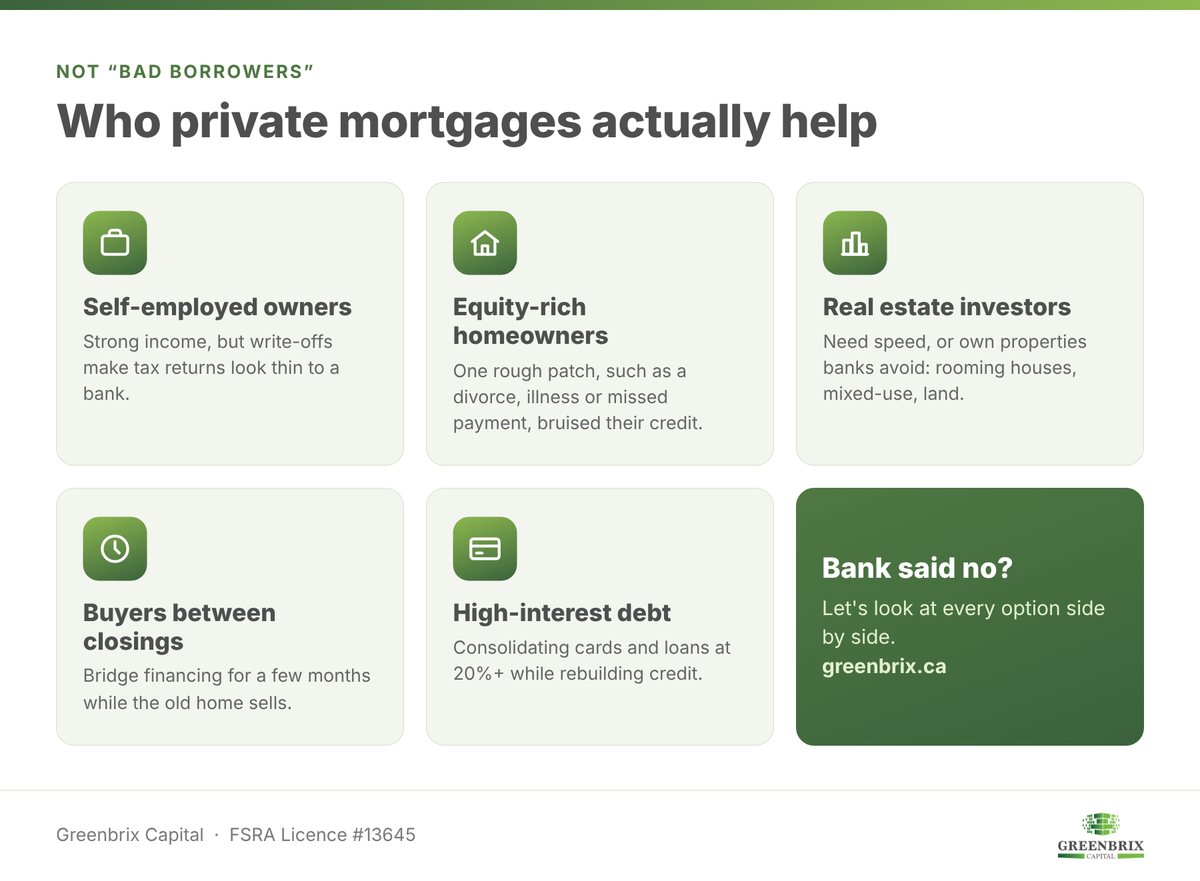
The stigma also hangs on because people assume private borrowers are “bad borrowers.” In my files, that is rarely true. Most private mortgage clients are:
- Self-employed business owners who make good money but write off enough to make their tax returns look thin to a bank.
- Homeowners with a lot of equity who had one rough patch: a divorce, an illness, a business slowdown, or a missed payment.
- Real estate investors who need to move faster than a bank or own properties banks do not like, such as rooming houses, mixed-use buildings or land.
- Buyers caught between two closings who need bridge financing for a few months.
- People with debt piling up at 20%+ interest who need to consolidate it while they rebuild.
Those are not people who failed. Those are people whose lives do not fit a bank’s checklist.
When a private mortgage can be the smartest move you make
1. Stopping high-interest debt from eating you alive
Credit cards, lines of credit, CRA arrears and car loans can quietly pile up. When they do, minimum payments can crush monthly cash flow and your credit score can drop, making the bank less willing to help.
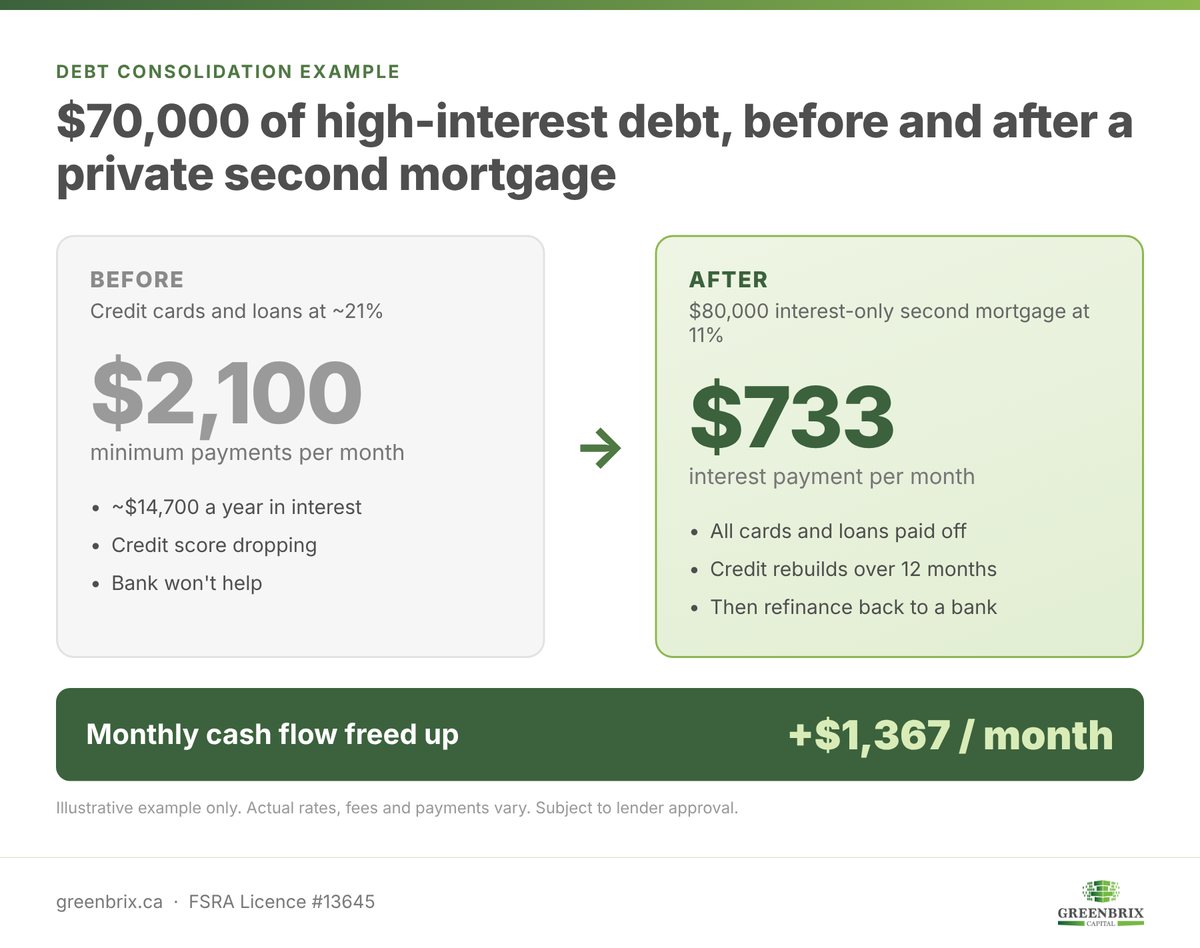
Here is an illustrative example. Say a homeowner in York Region owes $70,000 across credit cards and loans averaging about 21% interest. That is roughly $14,700 a year in interest, and minimum payments of around $2,100 a month.
Now say an $80,000 interest-only second mortgage at 11% pays it off, with the extra covering fees. The interest payment is about $733 a month. Even after one-time costs of around $4,000 for lender, legal and appraisal costs, the first year can cost less than the debt it replaced. The private mortgage was the bridge, not the destination.
2. Self-employed and “too good on paper” to qualify
A contractor may clear $250,000 a year, but after legitimate write-offs, the tax return shows $60,000. A private lender can look at the broader picture: bank statements, business revenue, and the equity in the property.
3. Saving a purchase or a closing
A buyer’s financing can fall through a week before closing, an appraisal can come in low, or the sale of the old house may not have closed yet. A private lender may be able to move in days, not weeks, but every file remains subject to review and approval.
4. Properties banks will not touch
Rooming houses, properties needing major renovations, raw land, rural properties, and mixed commercial and residential buildings can require a different lending conversation.
5. Buying time when things get serious
If a homeowner has fallen behind and a lender has started power of sale proceedings, a private refinance may be discussed. It is not guaranteed to stop legal proceedings; contact your lender and seek independent legal advice promptly.
What it really costs (no sugar-coating)
Private money costs more than bank money. Anyone who tells you otherwise is not being straight with you. These illustrative ranges move with the market, so always check your actual quote:
| Cost | Typical range |
|---|---|
| Interest rate, first mortgage | 6.00% to 9.99%, depending on loan-to-value, location, and property type |
| Interest rate, second mortgage | 9% to 13%, depending on the same factors |
| Lender fee | 1% to 3% of the loan, depending on whether it is a first or second mortgage |
| Broker fee | Varies with the complexity of the file |
| Appraisal | Usually $600 to $800 for a regular home; more for larger homes and commercial properties |
| Legal fees | Your lawyer's and the lender's lawyer's fees |
| Maximum loan | Up to 80% of the property's value for a strong property and borrower |
The rate depends on equity, loan-to-value, location, property type, and the strength of the exit plan. Judge the full cost against what the financing solves, not just the headline rate.
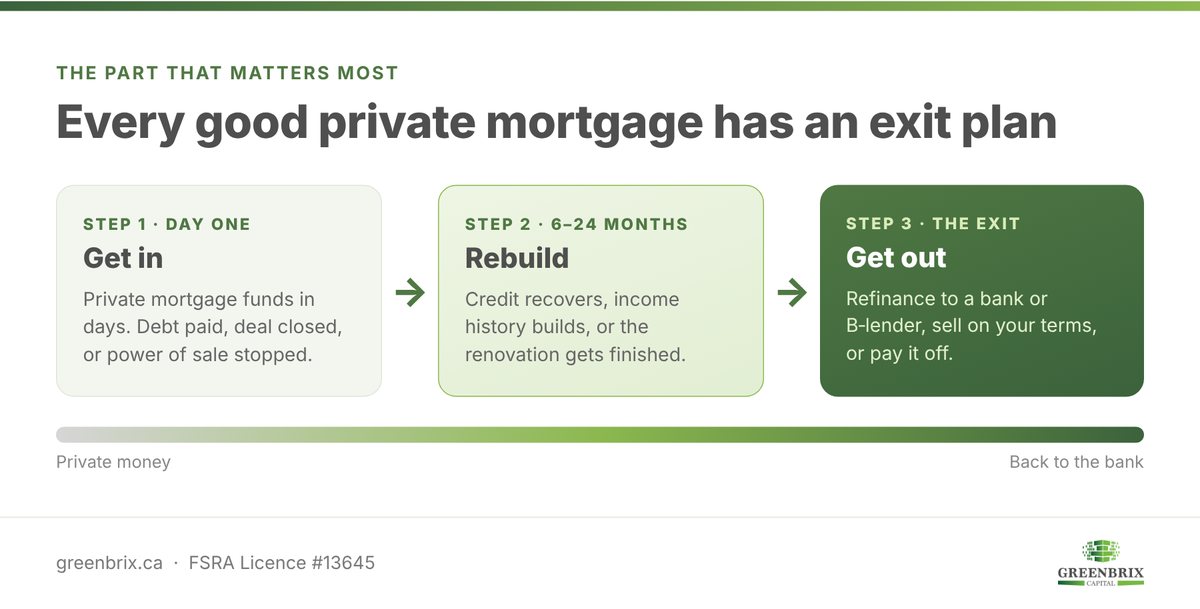
The secret every good private mortgage has: an exit plan
This is what separates a smart private mortgage from a dangerous one. Before you sign, you should know exactly how you are getting out. Common exits include refinancing back to a bank or B-lender, selling the property, or paying it off with an expected payment such as the sale of another property, an inheritance, or a business payout.
When I structure a private mortgage, the exit strategy is planned from day one. If I cannot see a realistic way out, I will tell you, because the worst outcome is a short-term loan that turns into a long-term problem.
Red flags: how to do this the right way
- Work with a licensed broker. Check that the brokerage and agent are licensed with FSRA.
- Get every cost in writing before you sign: rate, lender fee, broker fee, legal, appraisal and renewal fee.
- Ask about renewal and prepayment terms. Ask what happens if you need a few more months.
- Get independent legal advice. You should always have your own lawyer.
- Ask about the exit plan. A good broker cares as much about how you get out as how you get in.
Myths vs. facts
Myth: private mortgages are only for people with terrible credit.
Fact: Many private clients have good income and lots of equity; they just do not fit the bank's rules right now.
Myth: once you go private, you are stuck there.
Fact: Most private mortgages are designed to last 6 to 24 months, with a plan to move back to a bank.
Myth: private lenders want to take your house.
Fact: Professional private lenders make money on interest, not on power of sale.
Myth: it is all unregulated.
Fact: Mortgage brokerages in Ontario are regulated by FSRA, and borrowers must receive written cost and risk disclosure.
Frequently asked questions
How fast can a private mortgage close in Ontario?
Often within a few days to two weeks, depending on the appraisal, the lawyers and how quickly documents come in.
Do I need good credit for a private mortgage?
No. Private lenders focus mainly on your equity and your exit plan. Credit still matters for the rate you get, but it is not the deciding factor.
Can I get a private second mortgage behind my bank mortgage?
Yes. A second mortgage leaves your existing mortgage in place, which is useful if you have a great rate you do not want to break.
Will a private mortgage hurt my credit?
Most private lenders do not report to the credit bureaus. If you use it to pay off high-interest debt, your credit usually improves.
How long should I stay in a private mortgage?
As short as possible. Most clients are in one for 6 to 24 months before refinancing or selling.
The bottom line
A private mortgage is not a last resort. It is a specialist tool. In the right hands, with full transparency and a clear way out, it can stop the bleeding, save the deal, or buy you the time to get back to the bank on your own terms.
If the bank said no, or you are not sure whether a private mortgage makes sense for you, let’s talk. At Greenbrix Capital, we work with banks, B-lenders and private lenders, so we can show you options side by side and tell you honestly which one fits.
Book a free, no-pressure call with Greenbrix Capital
Greenbrix Capital, FSRA Licence #13645. All mortgages are subject to lender approval. Rates and fees shown are illustrative ranges and vary by property, borrower and market conditions. This article is general information, not financial or legal advice.